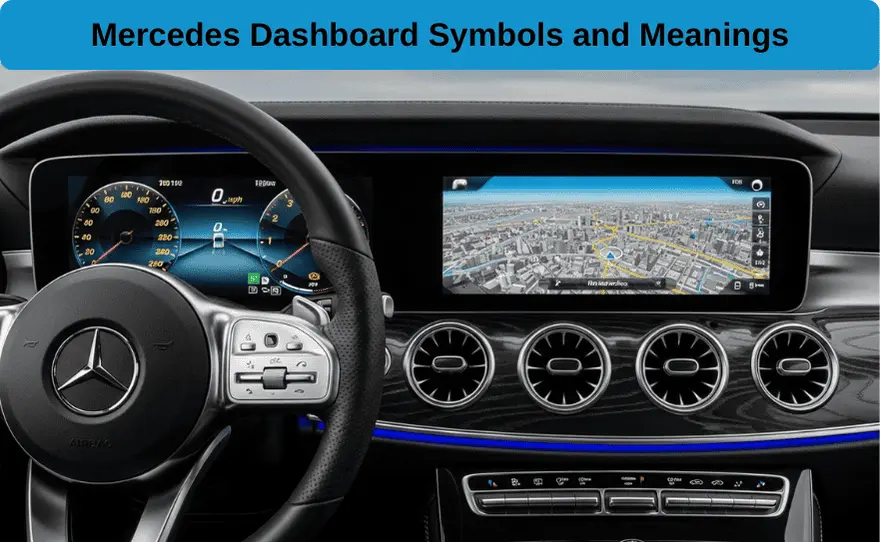
Your Mercedes-Benz instrument cluster is more than just a digital display. It acts as a real-time communication interface between you and your car’s onboard diagnostic networks. When a symbol lights up, it delivers critical data straight from the vehicle’s sensors. Knowing what these Mercedes dashboard symbols mean helps you prevent major mechanical failures, keep your safety systems active, and drive with total peace of mind.
Decoding Your Mercedes-Benz Instrument Cluster
Modern Mercedes-Benz vehicles use complex sensor networks and Signal Acquisition and Actuation Modules (SAM) to monitor your car’s overall health. Whenever a system operates outside its normal range, the main computer triggers a specific dashboard light. You should never ignore these alerts.
Understanding instrument cluster warning lights allows you to tell the difference between a simple routine maintenance reminder and a serious mechanical fault. If you drive a pre-owned model, understanding these alerts becomes even more critical. Knowing specific fault histories and the Mercedes S550 years to avoid can help you sidestep expensive electronic repairs and chronic dashboard warnings altogether.
The Universal Color Code: Indicators, Warnings, and Critical Alerts
Mercedes-Benz uses a universal color-coding system to show you exactly how urgent a situation is. This simple hierarchy helps you react quickly and safely without unnecessary panic.
- Green and Blue lights are standard indicators. They simply confirm that a feature, like your high-beam headlights or cruise control, is turned on and working normally.
- Yellow and Amber lights are warnings. They signal a malfunction or a maintenance need that requires your attention soon. You can usually keep driving safely for the time being, but you should schedule a diagnostic check.
- Red lights are critical alerts. These mean you face an immediate safety risk or a severe mechanical issue that requires you to stop the car.
Red Critical Warning Lights (Stop Immediately)
Red warning lights demand instant action. If one of these Mercedes dashboard symbols appears while you are driving, you must pull over safely and turn off the engine right away. Ignoring a red alert often leads to catastrophic vehicle damage or compromised passenger safety.
Engine Coolant Temperature Warning
This symbol looks like a small thermometer dipped in liquid. It means your engine is overheating. High temperatures can happen due to a coolant leak, a broken radiator, or a failed cooling fan. If you keep driving with this light on, you risk warping the cylinder head or completely destroying the engine block.
Engine Oil Pressure Warning
Displayed as an old-fashioned oil can, this light warns you of dangerously low oil pressure. Without proper fluid lubrication, the internal metal parts of your engine will grind against each other. Turn the car off immediately to prevent rapid, irreversible engine damage.
Brake System Warning
You will see the word “BRAKE” or a circle with an exclamation point. Sometimes, it simply means you left your parking brake engaged. If you release the parking brake and the light stays on, your car may have low brake fluid or a failing hydraulic system. Driving with this warning severely reduces your stopping power.
Supplemental Restraint System (SRS) / Airbag Light
This icon shows a seated passenger with an inflated airbag. It points to a malfunction in the airbag system or the seatbelt tensioners. If you get into an accident while this light is active, your airbags might not deploy, putting everyone inside the cabin at extreme risk.
Battery Charge Warning
The battery icon carrying a plus and minus sign means your car’s electrical system is failing to charge the battery. The culprit is usually a bad alternator or a snapped poly-v belt. Your vehicle will soon lose all electrical power and stall, so you need to get off the road safely before the battery drains completely.
Yellow and Amber Warning Lights (Check Soon)
Yellow and amber Mercedes dashboard symbols act as early warning systems. They alert you that a specific component is operating outside its normal parameters. While these lights do not usually require you to stop immediately, you should schedule a diagnostic check soon to prevent further damage.
Check Engine Light (MIL)
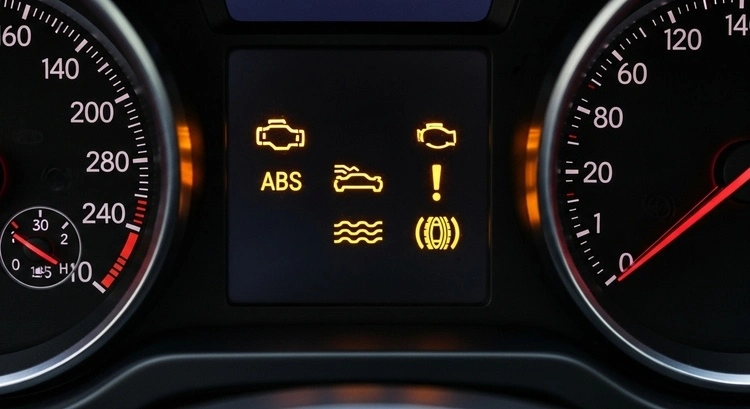
The check engine light points to a malfunction recorded by the Engine Control Unit. This light can trigger for minor issues, like a loose gas cap letting fuel vapors escape, or major problems, such as failing catalytic converters and faulty fuel injectors. If the light flashes, pull over immediately to prevent severe exhaust system damage.
Anti-Lock Braking System (ABS) Alert
When the ABS circle illuminates, your anti-lock braking feature is offline. Your standard brakes will still stop the car, but the system will not prevent your wheels from locking up during hard, emergency braking. You lose crucial steering control on slippery roads.
Electronic Stability Program (ESP®) / Traction Control
A yellow car icon with skid marks indicates your traction control is disabled. The Electronic Stability Program (ESP®) manages your lateral stability. Without it, your vehicle is far more likely to slide or spin out during sharp turns or wet driving conditions.
Tire Pressure Monitoring System (TPMS)
The TPMS symbol looks like a horseshoe with an exclamation point inside. It warns you that one or more tires have lost significant air pressure. Driving on underinflated tires ruins your fuel efficiency, compromises your handling, and greatly increases the risk of a blowout.
Brake Pad Wear Indicator
This circular icon bordered by dotted lines tells you your brake pads have worn down to their minimum safe thickness. You need to replace the friction material soon. Ignoring this alert leads to metal-on-metal grinding, which ruins your expensive brake rotors.
ATTENTION ASSIST® Light
Mercedes-Benz designed the ATTENTION ASSIST® system to monitor your driving behavior for signs of fatigue. If a steaming coffee cup appears on your screen, the system has detected erratic steering or delayed reaction times. It is time to pull over and rest.
Diesel-Specific Indicators
Diesel models like the Sprinter van feature unique alerts. A yellow coil represents the glow plugs; wait for this light to turn off before starting a cold engine. A fluid icon indicates low DEF (Diesel Exhaust Fluid) or AdBlue®. You must top off this fluid to keep your emissions system functioning and prevent the engine from entering a limited-power mode.
Green and Blue Indicator Lights (Normal Operation)
Green and blue dashboard lights are purely informational. They do not indicate any faults or dangers. Instead, they confirm that specific vehicle functions are active and working exactly as the manufacturer intended.
Active Headlamps, Turn Signals, and ECO Start-Stop
A blue headlight symbol confirms your high beams are illuminating the road ahead. Green arrows indicate your turn signals are flashing. If you see a green “A” surrounded by an arrow, your ECO Start-Stop system is active, automatically shutting off the engine at red lights to save fuel and reduce emissions.
Mercedes Dashboard Symbols by Model
Your instrument cluster display heavily depends on your vehicle’s specific class, drivetrain, and technology packages. Different models prioritize different diagnostic alerts based on their engineering.
C-Class and E-Class Notifications
Luxury sedans like the C-Class and E-Class focus heavily on advanced driver-assistance systems. You will frequently see alerts regarding lane-keeping assist, adaptive cruise control distances, and automated braking interventions designed for highway and city safety.
SUV and 4MATIC Alerts
If you drive a GLC, GLE, or any 4MATIC-equipped SUV, your dashboard monitors heavy-duty systems. You will see specific symbols for downhill speed regulation, off-road driving modes, and the AIRMATIC adaptive air suspension. A fault in the air suspension requires immediate attention to avoid an uneven, harsh ride.
High-Performance AMG Indicators
Mercedes-AMG models operate closer to their performance limits. Their dashboards display dynamic handling warnings, transmission temperature alerts, and launch control readiness. Because these cars drive aggressively, sensor warnings appear more often without necessarily indicating a mechanical failure.
What to Do When a Warning Light Comes On
Reacting correctly to a dashboard symbol saves you time, money, and stress. The color of the light always dictates your first move.
When It Is Safe to Continue Driving
If a yellow or amber light comes on and the car drives normally without strange noises or a loss of power, you can safely continue to your destination. However, you should limit your driving distance and book a service appointment to diagnose the stored fault code.
Resetting Dashboard Warning Lights
Many drivers try disconnecting the battery to clear a warning light. This is a bad idea. It erases helpful data and never fixes the underlying mechanical issue. The light will inevitably return. You need a proper OBD-II scanner to read the codes, fix the broken part, and then safely reset the system.
When to Schedule Expert Mercedes-Benz Diagnostics
You should always consult certified technicians when a warning light persists. Modern Mercedes-Benz vehicles require specialized, manufacturer-specific diagnostic software. Generic code readers often miss deep-level system faults. Booking an expert diagnostic service ensures your vehicle receives the exact repairs it needs to stay safe, reliable, and performing at its best.